|
Tips and Suggestion |
||||
|
|
||||
| Tips and Suggestions | ||||
| "The benefits of even the finest concrete vibrator are lost if the proper operating technique is not followed". | ||||
|
Proper vibrating techniques will:
|
Proper consolidation techniques will not:
|
|||
|
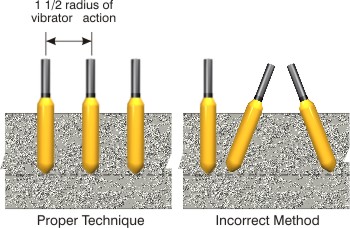
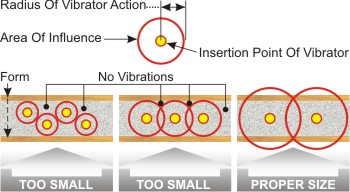
For Quality Concrete, Oztec Suggests: 1. Select the largest vibrator suitable for the job. 2. Insert the vibrator vertically, allowing it to sink to the desired depth by its own weight. Forcing it may lock it between rebars. 3. Hold the vibrator 5 to 15 seconds then slowly lift vibrator up, staying behind the trapped air's upward movement. Allow about 15 seconds for each 2 foot distance to avoid re-trapping air. 4. A slight up and down movement will close the hole formed by the vibrator. 5. Withdraw the vibrator quickly when near the top to prevent churning air into the top layer. 6. Move vibrator and re-insert at a distance 1 ½ times the Radius of Action…As shown in the diagrams. 7. Allow vibrator to pass 3 to 6 inches into the preceding layer to ensure knitting the two layers together, insuring a good bond and preventing "lift lines" when forms are removed. 8. Try to limit pours to 2 to 3 feet high, so air has less resistance to escape. 9. Do Not use vibrator to move concrete laterally…it causes segregation (use a shovel). Place vibrator in the center of mounds to knock them down. |

||||
|
Consolidation eliminates pockets of aggregate and air
bubbles maximizing strength, eliminating surface voids bringing
sufficient fine material to the surface and against the forms to
produce the desired finish. Vibrators consolidate concrete by
sending out shock waves which allows aggregate to “float” freely
while pushing lighter trapped air up and out of the mix. Vibrators
allow pouring stiff mixtures which are stronger,
more economical and result in less segregation, less
bleeding and less shrinkage cracks.. You know that you have consolidated concrete properly when a thin line of mortar appears along the form near the vibrator or the coarse aggregate disappears into the concrete. |
![]()
IMPORTANT: Trapped air moves upward in the mix from 1 to 3 inches per second. (1 inch in near 0 slump; 3 inches in 4 to 5 inch slump). |
|||
|
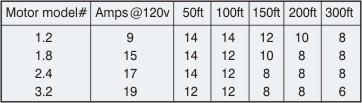
Extension Cord Wire Size Per UL Specifications:
Too light an extension cord can cause poor
performance and motor burn out. |
![]() |
|||
|
|
One page is not sufficient to describe the full scope of vibrating concrete. A fine source for more complete information are publications from ACI. | |||